
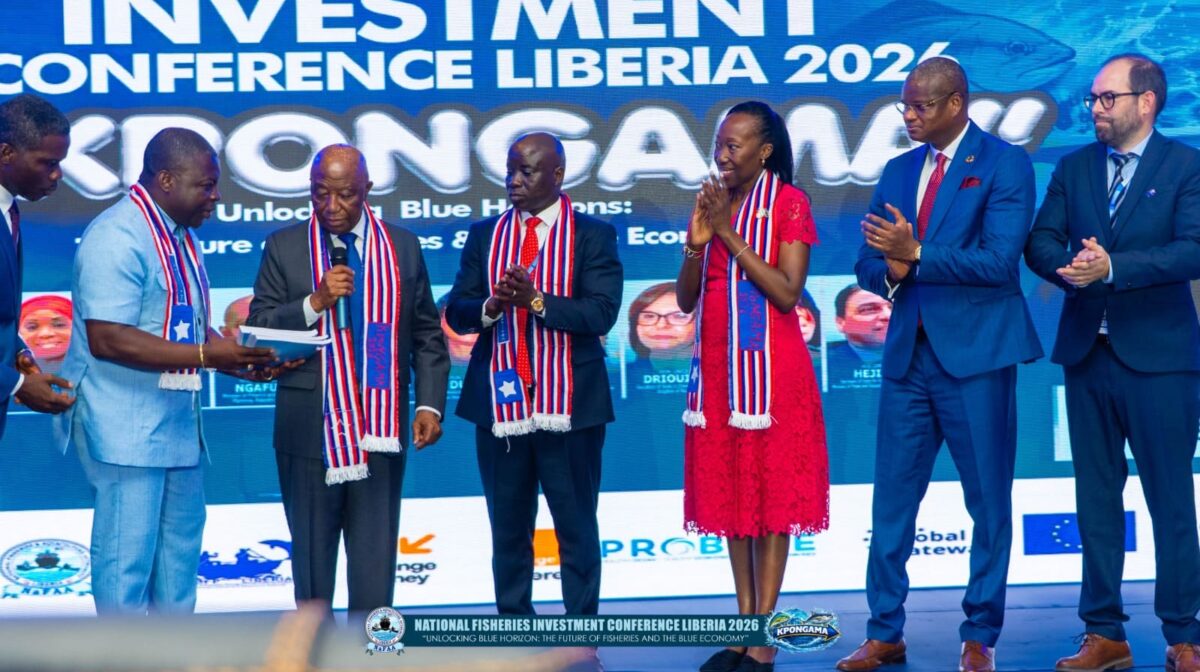
Liberia Opens Fisheries To Global Investment
HARBEL, Margibi County — President Joseph Nyuma Boakai opened Liberia’s flagship fisheries investment forum with a direct appeal to global capital, declaring the country ready for large-scale private sector engagement while cautioning against exploitative partnerships.
“We are open for business, but we are not open for exploitation,” Boakai said Monday at the National Fisheries Investment Conference 2026, held at the Farmington Hotel. “We want partners who will build local capacity, respect our environmental standards, and share the benefits with our communities.”
The National Fisheries Investment Conference was organized by the government of Liberia, the World Bank through its Liberia Sustainable Fisheries Management Project (LSFMP) and other development partners.
Positioning Liberia as an emerging frontier in West Africa’s blue economy, the president framed the conference not as a routine policy gathering but as a strategic pivot toward investment-led transformation.
“The foundations have been laid. The opportunities are expanding. The time to invest in Liberia’s fisheries is now,” he said.
A Sector Defined by Contradiction
Liberia is a country endowed with rich marine resources yet heavily dependent on imports and constrained by weak infrastructure.
“Liberia possesses 579 kilometers of coastline and vast marine resources,” he said. “Yet we import more than 33,000 metric tons of fish annually, and much of our high-value catch is landed in foreign ports because we lack the necessary facilities.”
He pointed to systemic gaps affecting small-scale fishers, who produce the bulk of domestic supply but operate without cold storage, modern equipment, or access to digital systems.
“Our artisanal fishers provide about 80 percent of our domestic production,” Boakai said. “Yet they operate without adequate storage, without modern tools, and too often without the dignity they deserve.”
NaFAA Sets the Investment Agenda
Providing the technical backbone to the president’s pitch, J. Cyrus Saygbe Sr., Director General of the National Fisheries and Aquaculture Authority (NaFAA), described the conference as a decisive shift from rhetoric to execution.
“Today, we move from potential to plan, and from plan to action,” Saygbe said in his welcome address.
He laid out the scale of Liberia’s untapped fisheries wealth, noting that the country’s waters contain hundreds of thousands of metric tons of commercially viable fish species, yet the sector continues to underperform due to illegal fishing, limited processing capacity, and weak infrastructure.
“For too long, the full value of this blue bounty has not been captured by the Liberian people,” he said. “This conference is our collective decision to end this era.”
Saygbe outlined a series of investment-ready opportunities, including development of an industrial fishing harbor with integrated cold-chain systems, expansion of aquaculture to reduce pressure on marine stocks, and modernization of landing sites and processing facilities.
He emphasized that the government’s role would center on governance, infrastructure, and regulatory stability, while the private sector would bring capital, technology, and operational expertise.
“We are not asking investors to walk this path alone,” he said. “We are committed to partnership.”
Finance Ministry: ‘A Case of Underinvestment’
Delivering remarks on behalf of Finance Minister Augustine Kpehe Ngafuan, the Deputy Minister for Economic Management, Mr. Dephue Zuo, framed Liberia’s fisheries challenge as structural rather than natural.
“This is not about resource scarcity,” he said. “It is about systemic underinvestment.”
He detailed the economic inefficiencies across the sector, noting that fisheries currently contribute only about 2 percent to GDP, while export earnings remain modest despite strong global demand for seafood.
“Our fishermen are working with artisanal equipment, our processing capacity is limited, and we lose up to 40 percent of our catch due to post-harvest losses,” he said.
He added that with targeted investment in cold storage, processing infrastructure, and value chain development, Liberia could significantly increase export earnings and create thousands of jobs, particularly for young people and women.
“Fisheries offers a rapid return on strategic investment,” he said. “This is a sector that can generate jobs, boost exports, and strengthen our economy within a short period.”
Regional Leaders Call for Coordination and Reform
The conference drew strong endorsements from regional ministers, who emphasized that Liberia’s ambitions are inseparable from broader West African cooperation.
Hon. Adegboyega Oyetola, Nigeria’s Minister of Marine and Blue Economy and Chairman of the Fisheries Committee for the West and Central Gulf of Guinea (FCWC), described the sector as central to food security and employment across the region.
“Millions depend on fisheries for income and sustainability, yet the sector continues to face declining stocks, limited investment, and weak infrastructure,” Oyetola said.
He stressed that sustainable management, increased investment across the value chain, and regional collaboration are essential to unlocking the sector’s full potential.
“No single country can tackle illegal fishing alone,” he said. “Stronger regional cooperation is essential.”
From Ghana, Hon. Emelia Arthur, Minister of Fisheries and Aquaculture Development, characterized Liberia’s move as a defining moment.
“This is not just a conference,” she said. “It is a declaration that Liberia is choosing to unlock its blue horizon.”
Arthur highlighted the importance of institutional strength, scientific research, and stakeholder engagement, noting that Ghana’s own progress in the blue economy has been driven by coordinated policy and political commitment.
“A blue economy without strong institutions is only an aspiration,” she said. “With strong institutions, it becomes transformation.”
Hon. Kenyeh Laura Barlay, Sierra Leone’s Minister of Planning and Economic Development, pointed to the shared coastline and economic interdependence between Liberia and Sierra Leone, describing the ocean as a “powerful engine for economic transformation.”
“Our coastlines form a contiguous stretch of nearly 1,000 kilometers,” she said. “This presents immense opportunities for fisheries, aquaculture, and maritime trade.”
She noted that while Liberia has abundant fish stocks, its per capita fish consumption remains lower than regional averages, signaling both a market gap and an opportunity for growth.
Her colleague, Hon. Princess Dugba, Minister of Fisheries and Marine Resources, reinforced the urgency of investment and management reforms.
“The fish resources of Liberia are currently untapped,” Dugba said. “This conference provides an opportunity to mobilize the investment needed to unlock that potential.”
She emphasized the importance of harmonized regional approaches, noting that shared marine ecosystems require coordinated governance and monitoring systems.
Foreign Affairs: Investment Through Diplomacy
Representing Foreign Minister Sara Beysolow Nyanti, Deputy Minister Ibrahim Nyei said Liberia’s fisheries push is aligned with its broader economic diplomacy strategy.
“When the president declared Liberia open for business, it was a deliberate effort to attract credible partnerships,” he said.
He highlighted ongoing bilateral agreements and international cooperation frameworks aimed at promoting trade, investment, and technology transfer in sectors including fisheries and maritime governance.
Communiqué Anchors Reform Agenda
The conference adopted a communiqué outlining a comprehensive reform and investment roadmap for Liberia’s fisheries sector.
Delegates called for urgent investment in fisheries data systems, digital monitoring, and scientific research to strengthen governance and combat illegal fishing, while also prioritizing aquaculture expansion, fish processing, and cold-chain infrastructure as key drivers of value addition.
The communiqué further emphasized the need for innovative financing mechanisms, including sovereign blue bonds and credit guarantees, to unlock capital and scale the sector.
It urged the Liberian government to increase budgetary allocations, strengthen institutional capacity, and operationalize a national blue economy strategy within 12 months.
